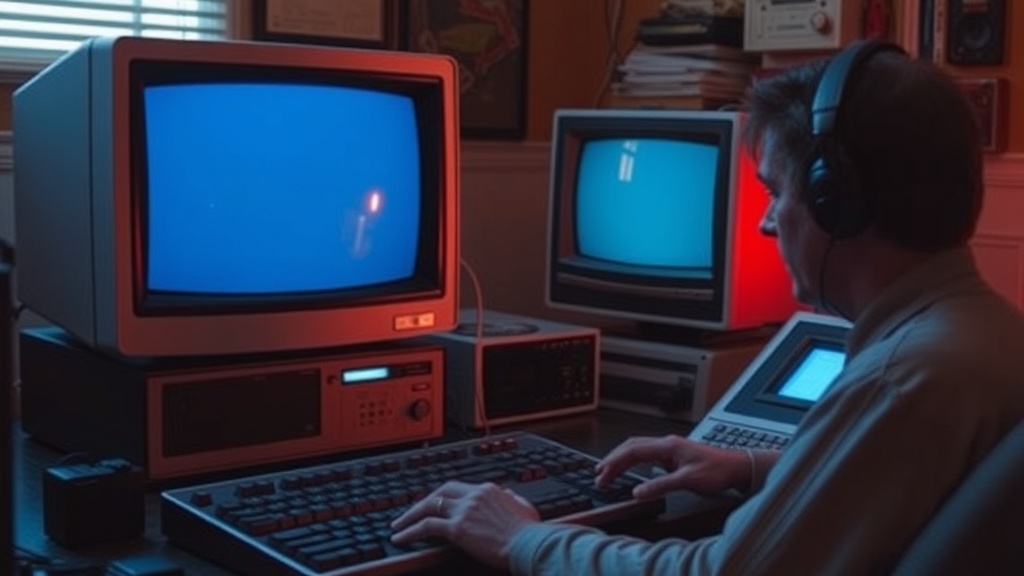
The Golden Age of Home Computers: Reliving the 1980s Revolution

This post covers the transformative era when home computers moved from hobbyist curiosity to household fixture — examining the machines that defined the 1980s, what made them special, and why they command serious attention (and dollars) in today's collector market. Whether you're hunting for your first Commodore or looking to complete a vintage setup, understanding this period matters because it shaped not just computing history, but how we think about technology itself.
What sparked the 1980s home computer revolution?
The personal computer explosion didn't happen in a vacuum. Several forces converged in the late 1970s and early 1980s to create something genuinely new — affordable machines that ordinary people could actually buy and use at home.
The Apple I had appeared in 1976, but it was really a kit for hobbyists. The breakthrough came when companies figured out how to sell complete, working computers at prices middle-class families could consider. By 1980, machines like the TRS-80 and Apple II were hitting department stores alongside televisions and stereos.
Here's the thing — it wasn't just about hardware getting cheaper. Software suddenly mattered. When VisiCalc arrived in 1979, it gave business people a reason to buy Apple IIs. When games like Oregon Trail and Zork appeared, kids found reasons to camp out in front of beige boxes. The machine became more than a tool — it became a destination.
Magazines like Byte and Creative Computing fanned the flames. They printed BASIC code you could type in yourself. (Yes, literally type — line by line, hoping you didn't make a typo.) Clubs formed. Users traded tips at school cafeterias and office break rooms. Burlington had its own share of enthusiasts meeting at libraries, swapping floppy disks in Ziploc bags.
The result? By 1983, Time magazine named the computer its "Machine of the Year" — the first time an inanimate object received the honor. That said, the bubble burst soon after. The video game crash of 1983 took many computer companies with it. But the foundation had been laid. Millions of people had experienced computing at home, and there was no going back.
Which 1980s computers are worth collecting today?
The most sought-after machines from the 1980s include the Apple II series, Commodore 64, TRS-80 Color Computer, Sinclair ZX Spectrum, and early IBM PC compatibles — though value varies dramatically based on condition, completeness, and rarity of specific models.
Not all vintage computers are created equal in the eyes of collectors. Some machines sold millions of units (making them easier to find but less valuable individually) while others had limited production runs that now command premium prices. The key is knowing what to look for.
The heavy hitters
The Commodore 64 remains the best-selling desktop computer model of all time — estimates suggest between 12.5 and 17 million units shipped. Because so many were made, a basic C64 in working condition might only fetch $50-100. But the catch? Boxed examples with original manuals, power supplies, and peripherals can command $300-500. The SX-64 — Commodore's portable version with a built-in monitor — regularly sells for $400-800 because far fewer were produced.
Apple's machines carry serious collector weight. An original Apple II (not the II+, IIe, or IIc) in working condition can easily reach $1,000-2,000. The Apple IIe, while more common, still attracts $200-400 for clean examples. Original disk drives, monitors, and the rare Silentype thermal printer add significant value to any Apple setup.
The TRS-80 line — affectionately nicknamed the "Trash-80" by fans and detractors alike — includes some genuine treasures. The original Model I (1977) is increasingly scarce because Radio Shack recalled many due to RF interference issues. A clean Model I with expansion interface and disk drives represents a holy grail for some collectors. The later Color Computer 3, with its improved graphics and memory, has developed a cult following.
British invaders and European gems
Across the Atlantic, the Sinclair ZX Spectrum dominated the UK market. Its distinctive rubber keys and rainbow stripe branding make it instantly recognizable. Early "Issue 1" boards with the thicker rim are particularly collectible. The ZX81, Sinclair's earlier machine, was impossibly cheap at launch (under $100 in the US as the Timex Sinclair 1000) and sold in huge numbers — but surviving examples with original packaging command respect.
The BBC Micro — built by Acorn Computers for the British Broadcasting Corporation's computer literacy project — rarely appears on North American shores. When they do surface, they're snapped up quickly by serious collectors who appreciate their build quality and educational legacy.
IBM and the business machines
The original IBM PC 5150 (1981) and PC/XT represent a different collecting philosophy. These weren't home computers in the recreational sense — they were serious business tools. Early IBM machines with matching monitors, original keyboards (the legendary Model F), and period-appropriate software carry historical significance that transcends mere nostalgia. A complete, working IBM PC setup can exceed $1,500 at auction.
| Computer | Years Produced | Typical Working Price | Rarity Notes |
|---|---|---|---|
| Commodore 64 | 1982-1994 | $50-150 | Very common; boxed sets command premium |
| Apple II (original) | 1977-1979 | $800-2,000 | Scarce; wooden cases often damaged |
| Apple IIe | 1983-1993 | $150-350 | Common; Platinum models slightly newer |
| TRS-80 Model I | 1977-1981 | $200-500 | Recalled units make survivors rarer |
| Commodore SX-64 | 1984-1986 | $400-800 | Limited production portable |
| Sinclair ZX Spectrum | 1982-1992 | $100-250 | UK market; shipping adds cost |
| IBM PC 5150 | 1981-1987 | $300-800 | Complete systems with monitors preferred |
| Atari 800XL | 1983-1992 | $100-200 | Common; peripherals harder to find |
Where should you start if you want to collect vintage computers?
Begin with a specific machine or era that genuinely interests you — not what's trending — and focus on acquiring a complete, working system rather than hunting rare components immediately.
The collector community divides roughly into two camps. Some pursue specific machines they used (or wished they used) back in the day. Others chase rarity and investment potential. Both approaches are valid, but mixing them without intention leads to scattered collections and empty wallets.
The local hunt
Burlington and surrounding areas offer surprising opportunities. Estate sales in older neighborhoods sometimes yield basement discoveries — Apple IIs forgotten in closets, Commodore monitors still wrapped in original boxes. Thrift stores occasionally price vintage computers too low because staff don't recognize their value. Worth noting: you'll compete with resellers who check these places daily, so consistency matters more than luck.
Hamfests — amateur radio swap meets — remain surprisingly good sources. Radio enthusiasts were often early computer adopters, and their gatherings attract sellers with technical knowledge who price fairly but expect buyers to know what they're looking at. The ARRL hamfest calendar lists events across the region.
Online marketplaces: navigating the waters
eBay dominates the vintage computer market, but it's a minefield of overpriced "untested" machines (translation: probably broken) and incomplete systems masquerading as complete. The key is patience. Set up saved searches with specific terms. Watch for auctions ending at odd hours — fewer bidders means better prices.
Here's the thing about shipping: it's brutal. A 25-pound computer with a CRT monitor can cost $80-150 to ship across the country, assuming the seller packages it properly (many don't). Local pickup options save money and let you inspect before committing. Facebook Marketplace, Craigslist, and OfferUp surface local deals, though they're increasingly picked over.
Specialized forums and communities
The Vintage Computer Federation forums represent the center of serious collecting discussion. Members trade machines, share repair knowledge, and organize the annual Vintage Computer Festival. The Buy/Sell/Trade section requires membership but offers better prices and more honest condition descriptions than general marketplaces.
Reddit's r/vintagecomputing community provides entry-level advice and "haul" posts showing recent finds. It's useful for gauging current market values and spotting trends, though experienced collectors often warn newcomers about common scams and overpriced junk.
What to look for (and avoid)
A working power supply is often the hardest component to replace. Old capacitors fail — it's not a matter of if, but when. If you're not comfortable recapping power supplies yourself, budget for professional service or factor replacement cost into your purchase.
Disk drives pose similar challenges. 5.25-inch floppy mechanisms suffer from deteriorated belts, misaligned heads, and dried lubricants. The Commodore 1541 disk drive — essential for any serious C64 setup — has a notorious alignment issue that causes "click of death" symptoms. Repair is possible, but it requires patience and specific tools.
Monitors are the third critical component. Many vintage computers output composite or RGB signals that modern displays can't accept without converters. Original CRT monitors provide the authentic experience but weigh a ton and require careful handling. The catch? Shipping a CRT is genuinely risky — they crack, they implode (rarely, but dramatically), and carriers hate them.
Why do these machines still matter?
Beyond nostalgia and collecting value, 1980s home computers represent a unique moment when individuals could truly understand the machines they used. You turned on a Commodore 64 and got a BASIC prompt immediately. No operating system loading, no updates, no abstraction layers — just you and the hardware, connected through a simple language.
That directness shaped a generation of programmers, engineers, and tech entrepreneurs. Steve Wozniak designed the Apple II himself. Clive Sinclair cut corners (sometimes too many) to hit price points that put computers in British living rooms. Jack Tramiel at Commodore declared that computers should be "for the masses, not the classes" — and delivered.
"The golden age of home computing wasn't about gigahertz or gigabytes. It was about access — the radical idea that regular people could own and control their own computers." — often attributed to early Byte magazine editorials
Today's collectors preserve more than hardware. They're maintaining the ability to experience software as it was originally intended — from the pixel-perfect display of an Apple II monitor to the distinctive click of a Commodore 64's keyboard. Emulators help, but they're approximations. The real machines tell the full story.
The market continues evolving. Machines that sold for pocket change at garage sales ten years ago now command serious prices. Speculators have entered the hobby, which frustrates some enthusiasts but validates the historical importance of these systems. That said, plenty of affordable entry points remain for curious newcomers willing to do their research and exercise patience.
The next time someone asks why you care about a beige box from 1983, you'll know exactly what to tell them — and maybe, just maybe, you'll inspire them to start their own journey into computing history.